Showing posts with label the common wealth. Show all posts

Tuesday, January 22, 2008

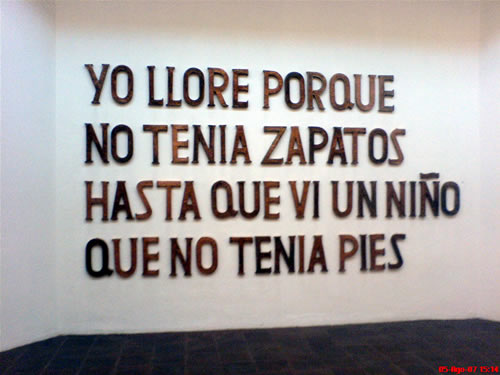
eduardo kingman


I saw this picture on a Bolivian blog (yeah, I'm all about working hard today) and it reminded me of Guayasamin (see below). I looked it up, and lo and behold, the painter is also Ecuadorian.


makes me feel like a huge jerk, but still, it's pretty cool.

Martin Luther King III's letter to John Edwards

From the Below Boston blog...

January 20, 2008

The Honorable John R. Edwards
410 Market Street
Suite 400
Chapel Hill, NC 27516

Dear Senator Edwards:

It was good meeting with you yesterday and discussing my father's legacy. On the day when the nation will honor my father, I wanted to follow up with a personal note.

There has been, and will continue to be, a lot of back and forth in the political arena over my father's legacy. It is a commentary on the breadth and depth of his impact that so many people want to claim his legacy. I am concerned that we do not blur the lines and obscure the truth about what he stood for: speaking up for justice for those who have no voice.

I appreciate that on the major issues of health care, the environment, and the economy, you have framed the issues for what they are - a struggle for justice. And, you have almost single-handedly made poverty an issue in this election.

You know as well as anyone that the 37 million people living in poverty have no voice in our system. They don't have lobbyists in Washington and they don't get to go to lunch with members of Congress. Speaking up for them is not politically convenient. But, it is the right thing to do.

I am disturbed by how little attention the topic of economic justice has received during this campaign. I want to challenge all candidates to follow your lead, and speak up loudly and forcefully on the issue of economic justice in America.

From our conversation yesterday, I know this is personal for you. I know you know what it means to come from nothing. I know you know what it means to get the opportunities you need to build a better life. And, I know you know that injustice is alive and well in America, because millions of people will never get the same opportunities you had.

I believe that now, more than ever, we need a leader who wakes up every morning with the knowledge of that injustice in the forefront of their minds, and who knows that when we commit ourselves to a cause as a nation, we can make major strides in our own lifetimes. My father was not driven by an illusory vision of a perfect society. He was driven by the certain knowledge that when people of good faith and strong principles commit to making things better, we can change hearts, we can change minds, and we can change lives.

So, I urge you: keep going. Ignore the pundits, who think this is a horserace, not a fight for justice. My dad was a fighter. As a friend and a believer in my father's words that injustice anywhere is a threat to justice everywhere, I say to you: keep going. Keep fighting. My father would be proud.

Sincerely,

Martin Luther King III

Tuesday, January 15, 2008

ode to stansfield tire

It's not every day I'm happy about customer service - just thinking about my experiences with Verizon and Bank of America gives me tiny little heart attacks. It's even less often I'm satisfied with the experience of getting my car fixed. But the dudes at Stansfield Tire have made my heart grow three sizes today.

I happened upon Stansfield Tire about two years ago when I moved into the neighborhood. I had previously been having my car serviced at the Source of All Worldly Evil, so I was pretty psyched the first time I went to Stansfield Tire and discovered that I don't have to pay $600 to find out that nothing's wrong with my car (or that every single solitary thing that has ever been wrong with me car is in fact, my own fault/"due to wear and tear"/not covered by my warranty. EFF YOU, IRA!)

So, back to the story here... Today I had driven to work in four-wheel drive, and on the ride home I put the car back into two-wheel drive. When I took my first left-hand turn of the trip, I heard a really loud, really disturbing pop/thud coming from my back driver's side wheel. I drove out of my way to make sure I had to take both a sharp right and a sharp left, and the noise happened only when I made a left. Plus the car had started to make a sinister groaning sound when I was going straight. I've always had some issues getting my car to switch between four- and two-wheel drive, but this time, none of my old standby tricks were working.

So I pulled into a gas station and called my friends at Stansfield Tire to see if they could take a quick look at my car before the end of the day. The guy who answered the phone proceeded to ask me a series of questions, analyze my problem over the phone and talk me through fixing it. In the time it took him to do this (quite a while), he could have told me to come in and made me pay an hour's labor. I also have to mention that he had no idea who I was, that I was a regular customer, or any of that. He was just being nice. Un. be. lievable.

In the end, what he told me to do (put it in reverse and back up 30 feet, some other crap I don't remember) worked like a charm and I didn't have to take the car in. On its own, this episode probably isn't that exciting or groundbreaking. But I've been this satisfied every single time I've dealt with these guys, with the exception of one kind of fatherly lecture ("It's an oil change every THREE thousand miles, young lady. Not eight thousand miles, not nine thousand miles.") Their nice service and lack of desire to rob me blind are just so refreshing I feel like shouting it from the rooftops. And whatnot.

So in the immortal words of Ice Cube, go to Stansfield Tire for all your tire and car repair needs.

Tuesday, November 27, 2007

if the kilo of cocaine and the machine gun weren't incriminating enough...

I just read this article about a dude in Lowell who had 40 POUNDS of pot FEDEXED to him AT HOME. But that's not the only funny part:

When local and state police searched his apartment they said they found baggies containing cocaine, another 10 pounds of marijuana, a bullet-proof vest under his mattress and a loaded 40-caliber semi-automatic handgun.

Under his bed they found a box with Soviet military writing on it containing 14 boxes of machine-gun rounds.

In the closet, police found an Ultimac Mac 90 machine gun with two, 30-round magazines.

They also found a magazine called High Times in the apartment.

Thursday, November 22, 2007


happy Thanksgiving, and don't forget forget that Friday is a holiday too.

Thursday, October 18, 2007

this is what you shall do

a Walt Whitman poem that one of my college professors had taped to the side of his desk, the side that faced the chair students would sit in when they came to see him. I think about it every so often, sometimes it makes me feel bad about myself, sometimes it makes me feel better.


This is what you shall do:

love the earth and sun, and animals,

despise riches,

give alms to every one that asks,

stand up for the stupid and crazy,

devote your income and labor to others,

hate tyrants,

argue not concerning God,

have patience and indulgence towards the people,

take off your hat to nothing known or unknown, or to any man or number of men,

go freely with the powerful uneducated persons, and with the young, and mothers of families.


Read these leaves in the open air every season of every year of your life:

re-examine all you have been told at school or church, or in any books,

and dismiss whatever insults your soul.

Tuesday, August 28, 2007

the lord's day

I skipped church on Sunday morning and went to the laundromat, where I washed some of my own clothes but mostly rags and cleaning cloths, soaked with homemade furniture polish from our training on Thursday. While I was there my boss stopped by with presentation copies from Kinko's, which all turned out to be missing the even pages. he went back and re-did them, and we met up later for some collating and a long conversation about organizational behavior.

after a long work-related afternoon, I took BART to Emeryville to meet up with Han, a friend from college. he lives with his sister in a cute little loft, where he cooked us some awesome thai curry. besides the sandwich I ate the first day we were here, it was my first home-cooked meal, and it was amazing.

after dinner we smoked some cigarettes on the porch and I talked about the strange hatred I felt towards the tourists I'd seen on Saturday. Living on Cape Cod for so long, I feel justified in hating the tourists there, because I depended on them for income and so often they were cheap jerks. But i was kind of surprised to find myself hating tourists here too, especially since technically, I'm one of them. Han made an excellent point, that there's a difference between the tourist who comes to "observe" from the outside, and the tourist who comes to be a part of what's going on.

While I'm certainly fascinated by the things that make this place different from my hometown(s), I make it a point not to come here acting like I'm at the zoo. In fact, I hate the very idea of zoos precisely because I think it's so offensive to observe animals like that. I'm sure I don't "fit in" here, but I try not to act like local things and local people exist simply for my enjoyment. I feel like a lot of tourists are here to extract and exhaust local resources, always ethnograph-izing about the strange and exotic things they see, which because they are tourists and confine themselves to tourist attractions suggested in guidebooks, aren't even representative of wherever they are.

So anyways, we talked shit about this kind of tourist for a while, then went to a store in Berkeley called the Elephant Pharmacy, where I tried not to ogle too much, despite the fact that it was the kind of place that inspires me to think I'm not in Kansas anymore. Oh, the irony. This "pharmacy," which I gather caters to UC Berkeley students, did sell all the regular pharmacy stuff, but was mostly stocked with stuff like $80 yoga mats and hemp stationery. We got some organic blueberry newtons and raw juice "health tonic."

Wednesday, August 08, 2007

dolla dolla bills

"what I learned in grad school" is popping up all over the place these days. here's an interesting tidbit from an article in the NYT. so interesting, in fact, that I'm not touching it with a ten-foot pole.


The image “http://graphics8.nytimes.com/images/2007/08/06/science/0807-sci-INDUSTRIAL-lrg.jpg” cannot be displayed, because it contains errors.

Monday, August 06, 2007

a brief foray into what I learned in grad school

kind of. in lieu of working I've been doing a lot of thinking, due in large part to Ben's recent post about commuting and unhappiness, followed by Amanda's incendiary comment about living in Lowell, and my recent discovery that I'll be living in Lowell for at least another year, if not longer.

so public transportation in Lowell basically sucks. the bus system is completely out of touch with the needs of people who would actually take the bus to get to work and back. the buses don't run often enough that you could take them and get to work on time, so the buses are often pretty empty. since there aren't enough people riding the buses to justify more routes or more frequent trips, the problem is kind of a vicious cycle.

the bus and train station used to be downtown (good) but when they expanded route 3 and the Lowell Connector, they moved the station to a weird location that's right off the highway, but a long walk from downtown. so ironically, the public transportation is now convenient only for people with cars. although I can't prove it, I suspect that a lot of these drivers live in the suburbs and spend their money outside of Lowell.

so the bus sucks, driving sucks (especially my car), there's no subway, and Lowell isn't especially bike-friendly. however, it's pretty easy to walk places in my neighborhood, and even more so downtown. There used to be a supermarket pretty close to my house, but they closed it and opened a shiny new one directly across the street from another supermarket, in a fancy neighborhood. apparently the hannaford brothers felt that maximizing their profits and squashing the competition were more important than my personal hunger. but there are a few convenience and liquor stores, a 24-hour Walgreens, plenty of restaurants, and some other good stuff within a few minutes walk, and another supermarket about a mile and a half away.

on a related note, I found a cool distraction called Walk Score that calculates the "walkability" of your address. you put in your address and it lists grocery stores, schools, parks, bars, libraries, movies, etc. within walking distance of your house, and rates the address on a scale from 0-100. my house got a 48 out of 100, which is better than I thought, but probably due to stuff like the claim that "Christine L. Allum, Independent Herbalife Distributor" is considered a "grocery store."

Walk Score can't tell you that the nearby bar is a super-shady dive, or that the supermarket closed a year ago. also, it seems to calculate distances "as the crow flies" as opposed to how you would actually walk there (you know, on streets and stuff). I MapQuest-ed a store that Walk Score said was 0.66 miles away, and found out it's more like 1.39 miles. anyhoo, I wouldn't use this to scope out potential places to live, knowing the reality of where I live vs. what Walk Score thinks, but it's a really good idea in theory. check it.

Tuesday, May 08, 2007

why we banned legos

something fascinating from an article in "Rethinking Schools," check it out:

Carl and Oliver,* both 8-year-olds in our after-school program, huddled over piles of Legos. They carefully assembled them to add to a sprawling collection of Lego houses, grocery stores, fish-and-chips stands, fire stations, and coffee shops. They were particularly keen to find and use "cool pieces," the translucent bricks and specialty pieces that complement the standard-issue red, yellow, blue, and green Lego bricks.

"I'm making an airport and landing strip for my guy's house. He has his own airplane," said Oliver.

"That's not fair!" said Carl. "That takes too many cool pieces and leaves not enough for me."

"Well, I can let other people use the landing strip, if they have airplanes," said Oliver. "Then it's fair for me to use more cool pieces, because it's for public use." (read more)


I think it's great, some people disagree. When I first read this I only found one response to it, written by a fairly reactionary and disingenuous conservative columnist. Now it seems this thing is getting to be a huge deal, and there are so many people talking and blogging and writing about it, it would be impossible for me to choose one or two to put up here. Just Google "why we banned Legos" and you'll get a barrage of opinions.

Anyways, I just think it's interesting that, agree or disagree with the decision to ban Legos, this thing has become exactly what the teachers feared it was - a huge allegory about society. As MRhé might say, it's pretty f-ing meta.

Wednesday, May 02, 2007

don't ask why, but I was reading an article about business manners earlier. tip #4, "Don't use technology as a substitute for interaction," points out that

This can be a bit harder if you're a member of the younger generation of workers, who grew up using e-mail for everything and may not feel completely comfortable engaging in long conversations.

is is just me or is that ridiculously disturbing?

Sunday, March 18, 2007

this week in homemade food

A quick note while I wait for the floor to dry... I did a lot of cooking this past week, starting with a beef stew extravaganza on Monday. I had some potatoes that were growing a few too many eyes, some carrots unfit for raw consumption, and three onions I bought when Homero moved in (that would be January). The weather was cold and blustery, and my fireplace, well, it doesn't exist. The moment, it seemed, was right for me to get my beef stew on for the first time this winter.

So I called my mom to demand her beef stew recipe, which is basic but amazing, and went down to Tha Sto to get some nice marbly stew meat. She said a pound of meat, but it just didn't look like it would be enough meat to satisfy my needs, so I got three. Then I had to compensate for what turned out to be waaaay too much meat by putting in a whole bitchload of other stuff, an ended up with too much stew.

You may be asking yourself, "can you ever have too much beef stew?" the answer, weirdly enough, is YES. 16 quarts of beef stew is officially TOO MUCH BEEF STEW. Please come over and eat some, I am so sick of beef stew and so is everyone else who has happened to walk into my house over the past few days. I live across the street from callery park and my door is always open to the tired, the cold, and those yearning to break free from beef stewlessness. Anyhow, for those of you who can't come over, or refuse to come over because "oh, I couldn't possibly drive to Lowell, that's in a different county!" I say, you're a pussy, but here's the recipe anyways. It's based only loosely on my mom's, and while it doesn't quite capture her mastery of all things stew, it's pretty f-ing delicious. I have more-or-less halved the amounts I actually used, so this will make about 8 quarts of delicious beef stew:

mix together some flour, salt and cracked pepper in a bowl. Put some stew beef in the bowl (like at least 2lbs) and mix it up till the beef is all covered in flour. Heat oil in your stockpot and add two chopped onions and at least two big spoonfuls of chopped garlic, sautee them for a minute or two then throw in the beef and brown it. there will be nasty stuff sticking to the bottom of the pot - don't worry, that's the 'flava.'

add 6 cups of liquid (some combination of wine, water, beer, worcestershire, hot sauce, and/or beef stock). I usually use however much wine I have in an open bottle, however much beef stock comes in those cartons, a few good tablespoons of Worcestershire and hot sauce, the open beer I may be drinking at the time, and the rest water. Bring it to a boil, stirring it occasionally to keep the beef chunks from sticking to the bottom of the pot. Reduce the heat, add two bay leaves, and simmer for at least an hour.

Add 4 big carrots, chopped, and simmer 20 minutes more. Add a bunch of chopped potatoes (like 5 medium or 3 large), 4 stalks of chopped celery, half a chopped rutabaga (way better than a turnip), some mushrooms/peas/green beans/whatever else is lying around, and, very important, one serrano pepper, seeded and diced up very fine. Simmer all that about 30 minutes more, or until the potatoes are nice and tender. Adjust the seasonings, salt, pepper, hot sauce, etc. and remove the bay leaves.

Turn off the heat and eat a bowl of stew to gauge the stew's thickness after cooling. It usually comes out perfectly thick, but anything can happen. if it is too thin for your taste, make a roux: heat (on medium) 4 tbsp of butter and add 6 tbsp flour, whisking constantly until it bubbles, then reduce the heat and whisk for a minute or two more. Add the roux to the stew and bring it back to a boil, continue to cook it for about 20-30 minutes. Don't thicken it with cornstarch, plain flour, or forget to cook it after adding the roux - the stew will taste like nasty raw flour.

Note: it's also easy to make this in a crockpot, just throw everything in together and crock it on low for at least 5 or 6 hours. If you're not much of a "solid chunks of beef" purist, there's really no upper limit - I once left it crocking for about 16 hours and it was perfectly delightful. If you do crock it, you should still brown the beef first with the onions and garlic.


During the snowstorm on Friday, Craig and Lydia came over to help me eat my beef stew and bake up some delicious apple spice cake, which I brought to Laurie's delicious boiled dinner. This cake is one of my favorite ways to use up mushy apples, and it looks so pretty, especially if you drizzle a little glaze on top (confectioner's sugar mixed with some OJ or water).

preheat the oven to 350 and butter (really lay it on thick unless you have a nonstick pan, trust me) and flour a bundt pan or tube pan. with a fork or a mixer, mash together two sticks of butter with 2 teaspoons of vanilla, 1 1/2 cups of brown sugar and enough maple syrup or molasses to make it easier to blend. The goal is to have a total of almost 2 cups of sugar-related ingredients, I usually mix it up according to what I have and getting the consistency I want (smooth but pasty, not liquidy, is the goal). then mix in 3 eggs, one at at time.

in another bowl put 3 cups of flour (white, wheat and pastry all work fine), a big teaspoon of salt, a half teaspoon of baking soda, and some cinnamon, nutmeg, and whatever other spices you like. I usually do like a teaspoon each of those and then half a teaspoon of cloves, sometimes a little allspice or fenugreek. The "actual recipe" calls for 1/8 tsp of mace, which I never have around, and one teaspoon of cinnamon (no nutmeg or cloves - but they're so delicious!) sift the dry ingredients together and add to the wet ingredients.

on the subject of the "actual recipe," when I finally located it I was surprised to find that it calls for 1 1/2 teaspoons of baking POWDER, but I swear to god I've always made it with 1/2 teaspoon of baking soda. I have no idea how I got it into my head to make it that way, but I've made this cake literally dozens of times and it always comes out pretty good. maybe I'll try it the other way next time and see what happens.

Locate a friend or someone who owes you a favor, and have them peel, core, and slice a bunch of apples. I've figured out that the amount of apples is totally irrelevant. I've used anywhere from two to six apples and it comes out fine no matter what, as long as you cut them up uniformly (sliced pretty small). I usually use cortland and/or macintosh apples, once I used granny smith and wasn't crazy about it because they don't get soft enough, even though the apples I used were way too soft to eat. Anyhoo, mix in your apples and at least a cup of nuts (I lean towards two cups because I really like nuts). I usually use walnuts, but this last time I didn't have enough so I used some pecans.

make sure everything's all mixed up well (you will probably have to use your hands to squish it up thoroughly if you use a lot of apples) and put it into the pan, bake it for an hour or so (it's done when you press on the middle and it feels only slightly mushier than the outside - or just use a toothpick, whatever). Let it cool for a few minutes before turning it onto a plate, and voila, delicious apple cake! let me know how it goes.

Friday, February 16, 2007

what's so funny about peace, love and understanding?

thank you, elvis costello, for getting this question out on to the airwaves. it's been bothering me for years now that people think there's something odd about three of the five of the things I stand for (the other two would be fairness and community).

when I heard this song on the radio this last night, I happened to be enjoying some of the delicious pasta I made on tuesday night with some friends. I'd give you the recipe but we don't "do" recipes, and that's kind of where I'm going with this - bear with me. OK, you really want to know?
- roast some walnuts
- and some green beans
- mix some feta with some olive oil, lemon zest, salt and pepper
- boil some linguine and throw it all together.

delicious. at the last minute we also threw in some leftover spinach from an equally delicious, and equally recipe-free spanakopita. that one is way too complicated to describe. it's all up here (imagine me pointing at my head). OK, so anyways, back to "where I'm going with this."

I have two super-awesome friends, Craig and Lydia, with whom I have three big things in common: 1) love of homemade food; 2) love of pooling resources, being communal, etc.; and 3) more-or-less abject poverty. One night a month or two ago, I looked into my fridge and nearly shed a tear when i saw it was full of once-appetizing food that was on the brink of going bad. I have two roommates with very enigmatic eating habits. One isn't around much and the other, I'm led to believe, just doesn't eat. So I'm always buying fresh fruits and vegetables but I rarely get around to eating them before they go bad. and although I do love to compost, I don't have the kind of disposable income where I can be wasting much food.

so I called Craig and Lydia and said, "Hey, I've got a bunch of crap that's about to go bad. Want to come over and help me cook it?" They came over with their crap that was about to go bad, and the rest is history. We've made some delicious food, including but not limited to various spanakopita renditions, meat pies, spinach pies, breads and pies, chicken stir fry, the aforementioned pasta thing, etc. etc. The first spanakopita we made, inspired by a bitchload of ground lamb I happened to have on hand, lacked nearly every single ingredient that's normally in spanakopita, except for the phyllo dough and eggs. It had a ton of ingredients, just none that are actually used in regular spanakopita recipes. Frozen asparagus? yeah, i'm never going to cook that shit - let's throw it in! spring mix? why not?

I just can't say enough about the virtues of our "cooking crap that's about to go bad" tradition - it's the manifestation of everything I live for - frugality, cooking, sharing, improvising, and making something out of nothing. I highly recommend that everyone find some friends who share these passions, and get a "cook crap that's about to go bad" club going. It's immensely satisfying and I think, getting back to the Elvis Costello song, it makes the world a little bit of a better place.

Sunday, December 17, 2006

public school

I spend a good amount of time trying to convince people that UMass Lowell is a great school, that it doesn't deserve its horrible reputation, and that I'm getting a super rigorous education (well, as rigorous as I can handle anyways).

Then UML decides to put THIS on their homepage to advertise how eeeeeeasy it is to get a few credits over winter break.

I have no words to describe how misguided this marketing scheme is, how many months of convincing this is going to set me back, how much lamer I now feel for being overwhelmed by my coursework...

Friday, December 08, 2006

tha woo

I went to Worcester with my boss/professor Bob yesterday. We did some interviews and one guy drove us around the neighborhood where I went to school when I was little. I didn't tell him that until we had already left the neighborhood, because I thought telling him would be like cheating.

It was so surreal though, to hear this guy talk about these places as if we were tourists (well, weird eccentric tourists who come to see abandoned factories and redeveloped affordable housing units). It was interesting to notice what he mentioned and pointed out and what he glossed over. Like I said, though, I kept my mouth shut.


I was sad that we didn't have more time after the interviews, I should have shown Bob some more Worcester, like this mural that I saw every day of my life for years:

It must have been done right after the Berlin Wall fell. The Perestroika and Glasnost were always there; the Target logo was not.

Friday, November 24, 2006

Thursday, November 23, 2006

Thanksgiving

"That was horrible.  If you want to end war and stuff you got
to sing loud
. I've been singing this song now for twenty five
minutes. I could sing it for another twenty five minutes. I'm
not proud... or tired.

So we'll wait till it comes around again, and this time with
four part harmony and feeling.

We're just waitin' for it to come around is what we're doing.

All right now.

You can get anything you want, at Alice's Restaurant
(Excepting Alice)
You can get anything you want, at Alice's Restaurant
Walk right in it's around the back
Just a half a mile from the railroad track
You can get anything you want, at Alice's Restaurant"

I have no idea why, but hearing this song on Thanksgiving
always makes me cry like a freakin' baby. Seriously, I don't
know what comes over me. I wish I had the kind of family that
sat down and listened to it all together, because there are
families that do that. My family, on the other hand, went to
a restaurant for Thanksgiving, which I consider to be the
gravest possible Thanksgiving sin. So I was forced to hear my
Alice's Restaurant in the car on the way to the restaurant.
Then I got lucky and heard it twice on the way home. Then
I got home and made the mistake of turning on NPR, and now
I'm seriously depressed.

I was all aggravated that I had to go to Worcester to spend
Thanksgiving with my family. This is the first year since
college that I have been home for Thanksgiving, and I would
have much preferred to spend the holiday working at the
restaurant as I've done in past years. I would bust my ass
all day from 11am to 11pm or later, never stopping for more
than thirty seconds to stuff a roll in my mouth, gulp down
some gingerale and bitters (Thanksgiving Eve what what) or
smoke half a cigarette in a single drag.

At the end of the marathon we were all sweaty, filthy, and
so beyond tired that our arms and legs felt more tingly than
achy when they finally stopped moving. We had mint jelly in
our hair, gravy in our shoes, and pecan pie encrusted our
shirt cuffs. But at the end of it all, after we all served
our last seated parties, the chefs started to dole out the
little styrofoam boxes - turkey, ham, or lamb with creamed
peas and onions, mashed potatoes, squash, and all the rest.
They always ran out of ham before the restaurant closed, but
the chefs always managed to pull one out of some mystery
location for me.

We were like people who had been stranded in the desert
getting our first taste of water
in a year. We all ate
standing up in the kitchen, styrofoam boxes spread out on
every available surface, bread board, salad bar, ice chest,
cardboard box. We barely talked, but looked at each other
as if sharing the happiest secret - it was almost over.
Even though we inhaled our food in a matter of minutes,
having to go back to check on tables or give checks or
whatever, that was the closest thing to a family Thanksgiving
I ever felt.

Earlier in the day we had fought with each other tooth and
nail for forks, and screamed that someone had taken the
wrong drinks or bumped into someone. Some of us cracked
under all the pressure, some of us broke down because of evil
customers, some of us cried because we got boiling water
dumped on us. In fact, one waiter organized a trifecta bet
every holiday, in which people picked the three waitstaff
most likely to break down first. At the end of it all,
though, we were all on the same team and knew that none of
us would make it through the day without everyone else.

I missed those
little styrofoam box Thanksgiving dinners
this year, and the people I used to stand around eating
them with.

Wednesday, November 08, 2006

more democracy in/action

Excerpt from D.E. Campbell's Why We Vote:


"On September 26, 1989, Traci Hodgson cast her ballot in Boston’s City Council election. It was the only vote cast in her precinct. For a number of reasons, the political science literature predicts that Traci should have been like the other 275 registrants in her precinct and not turned out to vote. She was only twenty-one, she had lived in Boston for less than two months, and she admitted that she was “not very familiar with the candidates running.” So why did she vote? When asked she replied, “I just think it’s important to vote. If you have the right, you ought to exercise it—whether you are going to make a difference or not” (Mooney 1989).

This book is about why Traci voted, and why she voted alone.

MADISON AND TOCQUEVILLE: A TALE OF TWO MOTIVATIONS

Our starting point in answering this question is not what did motivate Traci, but rather what did not. Clearly she did not vote to protect or advance her interests, as she admitted that she did not know enough about the candidates to select them on the basis of who best represented her. To someone with only a cursory familiarity with the study of American politics this may seem difficult to explain, as politics is typically described as a forum for the “clash of interests.” Equating politics with conflict underpins much of the political science literature and is an assumption shared by scholars working within many theoretical frameworks. I recall an introductory political science course in which a professor defined politics as the “scarcity of consensus.” In 1960, E. E. Schattschneider wrote simply, “At the root of all politics is the universal language of conflict” (2). Forty years later, Morris Fiorina and Paul Peterson note matter-offactly in their introductory textbook on American politics that “politics is fundamentally about conflict” (1998, xvi). For all the ink spilled by contemporary political scientists, however, no one has ever expressed this way of understanding politics better than James Madison in Federalist 10. Madison writes compellingly of how “the latent causes of faction are thus sown in the nature of man,” and that “the most frivolous and fanciful distinctions have been sufficient to kindle their unfriendly passions and excite their most violent conflicts” (1961, 79).

It does not seem, however, that Traci had her passions kindled as Madison describes. Instead, by her own account she was motivated by the glowing embers of obligation. She felt that she ought to vote, that it was her duty.

In invoking a sense of duty as a motivation to vote, Traci highlights a second, if more subtle, theme in both contemporary and classic writings on political engagement. If, in Federalist 10, Madison has written the quintessential statement on political participation as “protecting one’s interests,” then perhaps Tocqueville has written an equally quintessential description of political participation as driven by “fulfilling one’s duty.” In Democracy in America, Tocqueville observes that American political institutions lead citizens to see that “it is the duty as well as the interest of men to be useful to their fellows. . . . What had been calculation becomes instinct. By dint of working for the good of his fellow citizens, he in the end acquires a habit and taste for serving them” (1988, 512–13).

These two opposing views of politics are not merely the abstract statements of theoreticians, the political science rendition of how many angels can dance on the head of a pin. They also inform the writings and doings of political practitioners, with some of America’s founders as notable examples. Of course, Madison was one of the founders and, as noted, in his words we find a cogent description of how politics is inevitably defined by conflict. However, George Washington’s vision was of a republic free from strife among its citizens, in which citizens were involved in public affairs out of duty (Schudson 1998). Ironically, given their disagreements on so many other matters, Thomas Jefferson’s vision for the new republic mirrored Washington’s. Jefferson idealized a nation of small Tocquevillian communities, mentioning his ideal in almost every speech he gave (Morone 1990).

The ongoing debate between civic republican and liberal political philosophers over the nature of political life at the time of America’s founding underscores the two competing visions of democracy’s nature. In summarizing this extensive literature, James Morone writes,

[T]he dominant interpretation of liberal America focuses on the pursuit of self-interest. . . . In the republican view, the colonial and Revolutionary ideal lay, not in the pursuit of private matters, but in the shared public life of civic duty, in the subordination of individual interests to the res publica. Citizens were defined and fulfilled by participation in political community. (1990, 16, emphasis added)

The distinction between engagement driven by interests versus duty need not be seen as either/or. The very fact that evidence can be mustered to support both interpretations of the founders’ ideals suggests that neither one dominated to the exclusion of the other. Nor should we assume that the essential difference between engagement spurred by a threat to one’s interests and engagement motivated by a sense of civic obligation has faded over time. Indeed, the distinction between interest-driven and duty-driven engagement is at the core of this book, which is about contemporary patterns of public engagement in the United States."

read more...

So anyways, what I take from this is that there is a good, albeit never-discussed outside of this book, reason behind those ubiquitous and lame excuses of "I'm not voting because I don't like any of the candidates... "I don't know enough about the issues/candidates to choose..." "My vote doesn't really matter anyways..." "The whole political system is so fucked up I'm not voting just to protest it..."

The way I see it, not voting because you don't approve of the system is basically admitting defeat to the hegemonic two-party system. People in power have created and perpetuated this crazy dichotomy, which exists in such an intense form in very few countries (including the U.S.) So we don't have much choice if we want to vote for someone who is likely to win, but we do have a choice and we can't get scared off by the language of "conflict". Although which choice we make is crucial to each of us and our quests to further our personal interests, exercising the right to make the choice is crucial to our collective interest.

No, the world is not really separable into black and white, good and evil, Democrat and Republican - so it may seem unsatisfactory to have only those two choices before you. But by not voting to "protest" that, you are doing exactly what they want you to do. When less people vote, power remains concentrated in the hands of those who already have it. Although one vote may not matter much statistically, there's NO OTHER WAY to make changes. Unless, of course, the non-voters of the world are willing to put together a coalition, lobby and petition, run for office themselves, and go out into the streets to make their point. I am not saying non-voters are all kept away from the polls by laziness (although some might be) but rather that this frustrating political situation makes apathy a more reasonable choice for some people. However, those people shouldn't blame their apathy on the system, because they are the only ones who can change it.

As far as "not knowing enough" about the candidates or policies or ballot questions, I really can't come up with a polite way of saying that there's no excuse... Listen to NPR while you're in the shower or commuting. Watch the news in between commercials. Shop online for a candidate you agree with instead of shopping for a pink Teflon-coated frying pan. Read the newspaper, cnn.com, or The Nation instead of reading this blog. Fuck it, for all I care you can even watch a little Fox News - just don't listen too hard - while you're at the gym (why do they always have Fox News on in gyms?)

The point is, it does not require superhuman effort to be reasonably informed. In addition to learning about the candidates in your local elections, you will inadvertently learn about other stuff too. The latter will likely get you so fired up that you'll find it impossible to resist voting ever again. Even if it doesn't and you find my entire argument pointless, the frying pan will still be there.

Tuesday, November 07, 2006

election day

I didn't write this, which is all the more reason to read it:


Congressman John Lewis (GA-05), Chief Deputy Democratic Whip, delivers the Democratic Radio Address. In his address, Congressman Lewis celebrates the 40th anniversary of the Voting Rights Act and reflects on his own personal struggles and the struggles of everyday Americans in the 1960's to secure the right to vote for people of color. The Voting Rights Act is regarded as the seminal legislative accomplishment protecting the rights of voters of all backgrounds. It was signed into law by President Lyndon Johnson on August 6, 1965.


"Good morning. I'm Congressman John Lewis of Georgia.

Just 40 years ago in many parts of the American South, it was almost impossible for people of color to register to vote. Poll taxes, literacy tests, and grandfather clauses - as well as violence - were used to deny us this fundamental right.

People stood day-after-day in unmovable lines waiting on the courthouse steps trying to register to vote. And when they reached the front of the line, if they could not answer outrageous questions like, 'How many bubbles are in a bar of soap?' they were turned away. Doctors, lawyers, college professors, business owners, teachers, farmers, housewives were all told they could not read or write well enough to pass the test.

During the 1960's, the struggle to secure this most basic right involved the efforts of many brave Americans across the country. The cost was high: church burnings, bombings, shootings, and beatings.

It required the ultimate sacrifice of ordinary Americans: James Chaney, Andy Goodman, and Mickey Schwerner, who simply sought to register voters, Jimmie Lee Jackson, whose death precipitated the famous march from Selma to Montgomery. These names are forever etched in our nation's history; they died for the cause of freedom.

On March 7, 1965, I marched with 600 men and women to draw attention to Jimmie Lee Jackson's death. We left Brown Chapel AME Church in Selma and walked two-by-two down the sidewalk - not in the middle of the street - and when we reached the crest of the Edmund Pettus Bridge we saw a sea of blue Alabama state troopers.

We kept on marching on that bridge crossing the Alabama River. And Hosea Williams, who was leading the march with me, turned to me and asked, 'John, can you swim?' I said, 'No, Hosea, I can't swim. We're not going back. We're not going to jump. We're going forward.' And we continued to march within steps of the troopers.

We were beaten, tear gassed, and trampled by horses on that bridge. We paid a price, but that's what it took to bring voting rights for people of color in America. The events of 'Bloody Sunday,' as it came to be known, aroused the conscience of the nation. Under President Lyndon Johnson's strong leadership, the nation responded and Congress passed the Voting Rights Act. President Johnson signed it into law 40 years ago today.

The Voting Rights Act provided extensive protections by prohibiting any voting practice that would abridge the right to vote on the basis of race. It effectively abolished poll taxes and literacy tests and provided for criminal and civil sanctions against persons interfering with the right to vote.

Our nation's history is one of expanding rights. In 1975, the Voting Rights Act was amended to require bilingual ballots and voting assistance in areas with significant language minority citizens. English-only ballots had the effect of serving as literacy tests for Latinos and Native Americans who were non-English speaking voters. In 1982, the Voting Rights Act was amended to protect the rights of voters with disabilities.

Thanks to the Voting Rights Act, today there are 81 Members of Congress of African American, Latino, Asian, and Native American descent, and thousands of minorities in elected offices around the country.

Our democracy depends on protecting the right of every American citizen to vote in every election. We must honor the legacy of all who died in the struggle for civil rights. We must renew our commitment to remove obstacles to the right to vote. Democrats are committed to protecting the right to vote, and will work to reauthorize and strengthen the sections of the Voting Rights Act that are set to expire.

We cannot forget that people sacrificed and died for the right to vote. They didn't die in Vietnam or Iraq. They didn't die in South America or Eastern Europe. They didn't die in Africa or Southeast Asia, they died right here in the United States, trying to exercise their Constitutional right to vote.

The moral value of our society is defined by the veracity with which we defend the dignity of humankind. We need to continue to address these needs if we want to build an interracial democracy where all Americans are treated with dignity and respect, what I like to call the Beloved Community.

I'm Congressman John Lewis. Thank you for listening."